


d-AI-logue project at IEEE SA Nexus Series
How can AI-enabled systems be trusted? How do AI design, governance and global standards come together—and, ultimately, how do they shape responsibility towards users?
The d-AI-logue project was showcased as a real-world example during the latest IEEE SA Nexus Series, since d-AI-logue assistant – an AI-oriented system – was designed within it. The webinar, “Supporting Responsible Digital Transformation: Lessons from Real-World Engagements in Greece,” took place on 24 September 2026.
Alexandros Nousias (National Centre for Scientific Research “Demokritos”) and Denia Psarrou (IEEE SA) discussed critical issues of ethics, governance, transparency and responsible design, particularly when AI systems are developed for children and young people. They also explored best practices and current developments in standardisation. The discussion was moderated by Moira Patterson (IEEE SA).
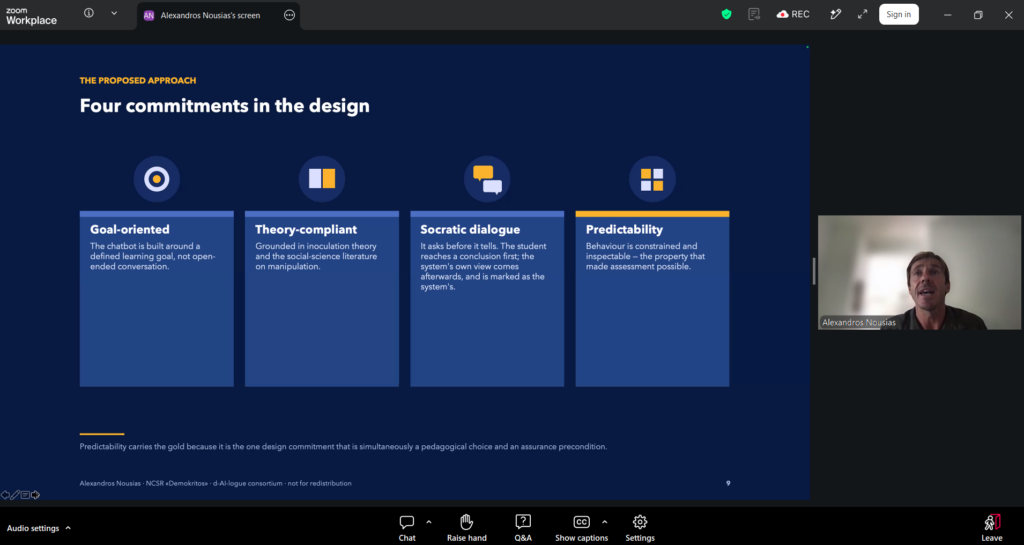
Alexandros Nousias presented the different stages in the design and development of d-AI-logue assistant, an AI-oriented system, including its alignment with the EU AI Act and relevant IEEE SA standards. He highlighted the practical and essential steps involved in building trustworthiness into an application intended for use in schools, particularly when minors and young people are involved.
He also highlighted the contribution that an independent assessment by an external review organisation can make to the credibility and trustworthiness of an AI system.
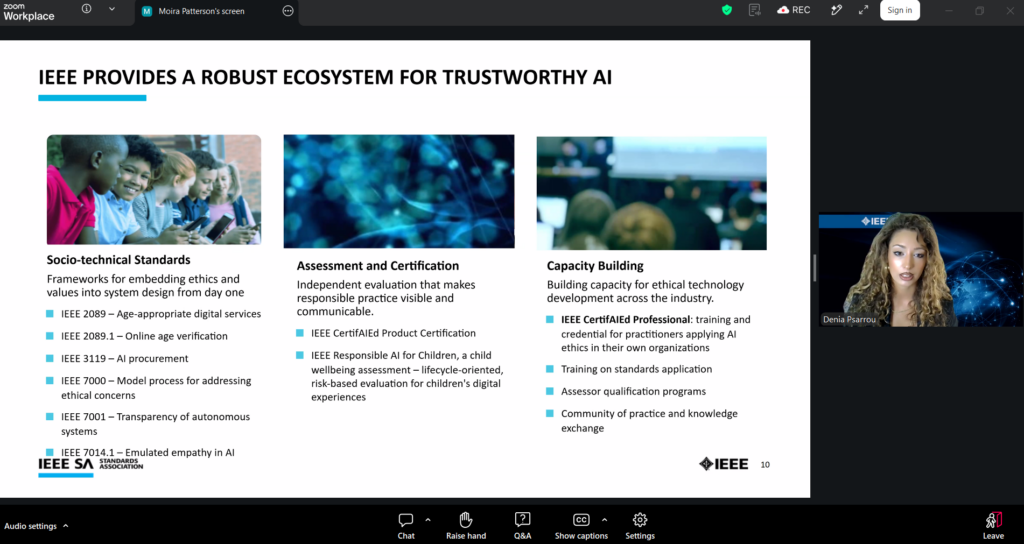
Denia Psarrou emphasised the importance of responsible and trustworthy AI development for children and young people, as well as the range of standardisation tools available to support this process. She also explained existing frameworks for embedding ethics and values into system design from the outset, rather than adding them later, helping to support their co-evolution with the technology and their efficiency.
For the development of d-AI-logue assistant, following relevant socio-technical standards from the outset was a key part of the process and integrated part of the project’s social and educational mission.